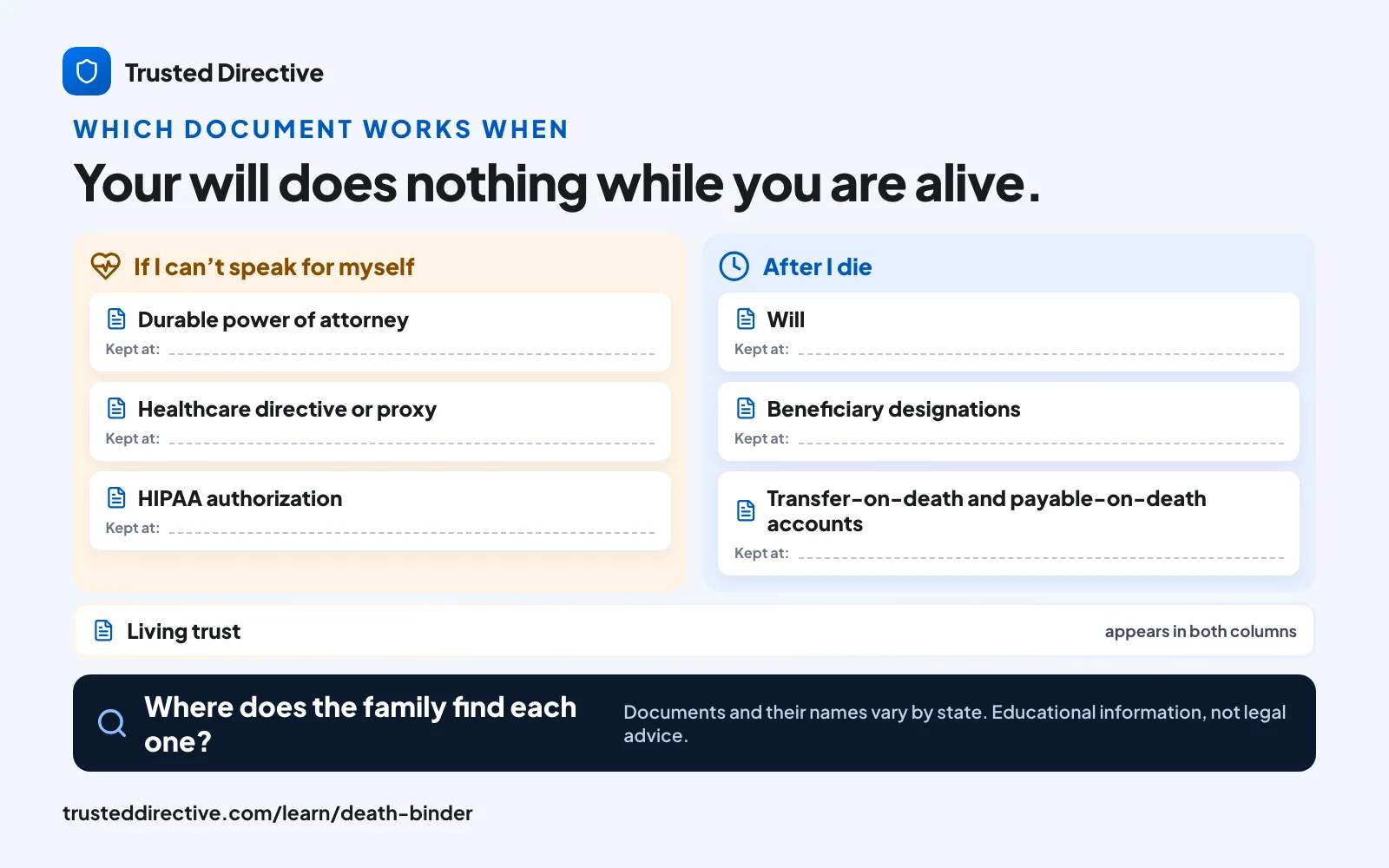
At 40: when other people depend on you
At 40 the arrangements are mostly about the people who would be affected if
something happened suddenly.
A will that names a guardian
If you have minor children, a will is where most parents nominate a guardian. The
court makes the final decision, but your nomination is what it starts from. Without a
will, your state’s intestacy rules decide who inherits, and the court appoints
an administrator in place of an executor
(Cornell LII).
Beneficiary forms after every life change
This is the fastest fix on the list. Pull up the beneficiary on your workplace
retirement plan, any IRA, and any life insurance. FINRA recommends reviewing them
after major life events, because a designation stays valid through a marriage, a
divorce or a birth until you change it (FINRA).
An ex-spouse named in 2009 is still named.
A named health care agent
If you were in an accident tomorrow, who would the hospital ask? A durable power of
attorney for health care answers that in advance. In most states the person you name
must be at least 18
(NIA).
Children turning 18
Under HIPAA, a parent acts for a child’s health information as the
child’s “personal representative,” and state law decides when that
ends, usually at the age of majority
(HHS).
After that, living at home or staying on the family insurance does not change it. An
adult child can sign their own health care and financial documents naming a parent,
if they choose to.
At 60: the decade the deadlines start
In your 60s, federal programs start attaching dates to your decisions.
Medicare’s enrollment window
Your Initial Enrollment Period for Medicare lasts seven months: it starts three
months before the month you turn 65, includes that month, and ends three months after
(Medicare.gov).
Put the dates on a calendar the year you turn 64.
When to claim Social Security
You can start retirement benefits as early as 62 at a reduced amount. Waiting past
your full retirement age earns delayed retirement credits, which stop at 70
(SSA).
This is a household decision, especially for a married couple, and worth modeling
with the SSA’s own planner or an advisor.
Long-term care
According to LongTermCare.gov, run by the federal Administration for Community
Living, someone turning 65 today has almost a 70% chance of needing some type of
long-term care services
(ACL).
How you would pay for care, and who would coordinate it, is easier to think through
at 60 than at 80.
Fewer accounts to find
Every dormant account is one more thing your executor has to discover. Consolidating
old 401(k)s, idle savings accounts and cards you no longer use shrinks the list
before anyone else has to reconstruct it.
Re-reading who you named
Look at who you named a decade ago as agent, executor and beneficiary. People move,
fall out of touch, get sick, or die. A document naming someone who can no longer act
can leave your family where they would be with no document at all.
At 75: making it reachable
By 75 most of the paperwork usually exists. The work shifts to making sure it can be
used.
Required distributions are running
Withdrawals from traditional IRAs and most workplace retirement plans generally must
begin at age 73
(IRS).
Know which accounts pay them, and make sure whoever would handle your finances knows
too.
Backups for everyone you named
Name a second agent under each power of attorney, and a backup executor. If your
first choice is your spouse, your backup is who your family will actually rely on.
Copies where they’re needed
An advance directive in a desk drawer does little in an emergency room. NIA suggests
giving copies to your health care proxy and your doctors
(NIA).
Final wishes, in writing
Burial or cremation, a service or none, anything prearranged and paid. Writing it
down spares your family from guessing during the worst week.
The conversation
The checklist ends with a talk. Tell your executor and agents where things are, what
exists, and what you want.
At any age: the part nobody writes down
Every arrangement above assumes someone can find it. That is the step most families
skip, and it’s the reason organized people still leave their families a search.
What to record, and how to keep it, is its own job. Our
death binder guide covers what to record and
where, and the checklist you fill in
turns it into a form you can print.
Two digital steps take ten minutes each. Set legacy contacts on your
accounts: Apple’s legacy contact and
Google’s Inactive Account Manager
only help if they were switched on in advance. And read about
the verification-code problem:
a password list stops working when the sign-in code goes to a locked phone. For the
bigger picture, see
what happens to your accounts when you die.
One more, and it’s free: search your own name in the state unclaimed property
databases. Most states can be searched at once through MissingMoney.com, which the
state administrators’ association sponsors
(NAUPA). If you find
something, you just saved your executor a search.
What this checklist can’t decide for you
Whether you need a trust, which power of attorney form your state accepts, how to
title a house, and whether a transfer-on-death designation fits your situation are
legal questions. The answers depend on your state and your family. Questions worth
bringing to an estate attorney:
- Does my state recognize the power of attorney and health care forms I already have?
- Do my beneficiary designations and account titles match what my will says?
- If I became unable to decide for myself, what would my family need, and what could they not do?
- Who would be appointed if my executor could not serve?